

Present Continuous Tense – In Real-life – What Is Happening Right Now?
Learn English through Real-Life Events and Global News
Takeaways: By the end of this lesson, you will be able to:
- understand when to use the Present Continuous Tense.
- talk about actions happening now.
- describe temporary situations.
- discuss current events from around the world.
- talk about changes taking place.
- ask and answer questions naturally.
Warm-up
Look around your classroom or home.
Complete these sentences.
- I am __________________________.
- My teacher is __________________________.
- My friend is __________________________.
- People outside are __________________________.
Now compare your answers with your partner.
Situation 1: Right Now
Imagine you are watching a live news channel.
The reporter says:
“Firefighters are fighting a forest fire.”
“Doctors are treating injured people.”
“Volunteers are helping families.”
These actions are happening at this moment.
Structure – Click on to know the expanded forms of he,she it & they and the subject
| Subject | be verb (helping verb) | verb + ing |
|---|---|---|
| I | am | working |
| He | is | speaking |
| She | is | driving |
| It | is | raining |
| We | are | learning |
| You | are | reading |
| They | are | building |
When Do We Use the Present Continuous?
We use it for:
✅ actions happening now
✅ temporary activities
✅ events happening around the world
✅ changes taking place
Example 1 – Live News
Imagine you are watching television.
- Scientists are studying a new disease.
- Rescue teams are searching for survivors.
- Engineers are repairing a damaged bridge.
- Farmers are harvesting rice.
- Students are writing their exams.
These actions are happening now.
Example 2 – Everyday Life
- My mother is cooking dinner.
- My father is watching the news.
- I am doing my homework.
- My brother is playing football.
- We are waiting for the bus.
Real-Life Examples from Today’s World
Read these sentences.
- Many countries are investing in renewable energy.
- Companies are using artificial intelligence in customer service.
- Universities are offering online courses.
- Electric vehicles are becoming more popular.
- Scientists are exploring the deep ocean.
- Tourists are visiting Japan during the summer.
- Many people are working from home.
- Hospitals are improving digital healthcare.
- Space agencies are preparing new Moon missions.
- Students are learning coding at school.
How to Make the Present Continuous
Positive
Subject + am/is/are + Verb-ing
| Subject | Verb | Reading a book Planting Trees Learning English Watching a TV Programme |
| I | Am | |
| We you they | are | |
| He she it | is | |
| Who (Singular) | is | |
| Who (Plural) | are |
Examples
- She is reading a book.
- They are planting trees.
- We are learning English.
Negative
Subject + am/is/are + not + Verb-ing
| Subject | Verb | Reading a book Planting Trees Learning English Watching a TV Programme | |
| I | Am | Not | |
| We you they | are | Not | |
| He she it | is | Not | |
| Who (Singular) | is | Not | |
| Who (Plural) | are | Not |
Note: Are not = Aren’t, was not = wasn’t is not = isn’t
Examples
- I am not sleeping.
- He isn’t driving.
- They aren’t playing football.
Questions
Am/Is/Are + Subject + Verb-ing?
| Verb | Subject | Reading a book Planting Trees Learning English Watching a TV Programme |
| Am | I | |
| Are | We you they | |
| Is | He she it |
Examples
- Are you listening?
- Is she studying?
- Are they travelling?
Short Answers
Are you learning English?
Yes, I am.
No, I’m not.
Is he working?
Yes, he is.
No, he isn’t.
Present Continuous for Temporary Situations
Sometimes the action is not happening exactly now.
It is happening around this period.
Examples
- My cousin is preparing for the IELTS exam.
- I am reading an interesting history book.
- Our school is organising a science exhibition.
- My friend is learning German.
- The company is training new employees.
Present Continuous with Time Expressions
We often use
- now
- right now
- at the moment
- today
- this week
- this month
- this year
- these days
Examples
- We are learning grammar today.
- My sister is staying with us this week.
- The city is building a new metro line this year.
- Many schools are introducing AI lessons these days.
Present Continuous for Change
We use it when something is changing.
Examples
- The weather is getting hotter.
- Cities are becoming smarter.
- Internet speed is improving.
- The population is growing.
- Air pollution is increasing.
- Technology is changing our lives.
- Online education is expanding.
- Renewable energy is replacing fossil fuels.
Vocabulary
| Word | Meaning |
|---|---|
| invest | put money into something |
| renewable | energy that can be used again |
| explore | travel to learn more |
| prepare | get ready |
| improve | become better |
| increase | become larger |
| reduce | make less |
| develop | grow or create |
Common Mistakes
❌ She is drive to work.
✅ She is driving to work.
❌ They are study now.
✅ They are studying now.
❌ I am go home.
✅ I am going home.
❌ He are working.
✅ He is working.
Speaking Activity
Ask your friend (It is better you talk to youself)
- What are you doing after class?
- What book are you reading?
- What are you learning these days?
- Are you using AI to study English?
- Is your family watching any TV series?
Pair Work
Student A asks.
- Are you learning any new skills?
- Are you exercising regularly?
- Are you watching any interesting documentaries?
Student B answers using complete sentences.
Example
Yes, I am learning graphic design.
No, I’m not watching television these days.
Reading Practice
Read the paragraph.
Today, people around the world are experiencing many changes. Scientists are developing cleaner energy. Schools are introducing digital learning. Companies are creating new AI tools. Doctors are improving medical treatments. Farmers are using smart technology to grow crops. These innovations are changing everyday life.
Answer:
- What are scientists developing?
- What are schools introducing?
- Who is improving medical treatments?
- What are farmers using?
- What is changing everyday life?
Fill in the Blanks
Choose the correct verb.
- She ________ (is reading / reads) a science magazine now.
- They ________ (are planting / plant) trees today.
- We ________ (are learning / learn) English at the moment.
- The company ________ (is hiring / hires) new employees this month.
- Scientists ________ (are studying / study) climate change now.
Correct the Mistakes
- She are driving home.
- They is watching television.
- I am write an email.
- We is playing cricket.
- He are studying English.
Speaking Challenge
Imagine you are a TV reporter – Report five live events.
Example
“Good evening. Rescue workers are helping people after heavy rain. Volunteers are distributing food. Engineers are checking bridges. Police officers are directing traffic. Doctors are treating injured people.”
Quiz
Choose the correct answer.
1. Which sentence is correct?
A. She is cook dinner.
B. She is cooking dinner.
C. She cooking dinner.
2. Which action is happening now?
A. I play football every Sunday.
B. I am playing football now.
C. I played football yesterday.
3. Which sentence shows change?
A. Water boils at 100°C.
B. Cities are becoming greener.
C. Birds fly.
4. Which sentence is correct?
A. They are studying today.
B. They studying today.
C. They is studying today.
5. Choose the correct question.
A. Are she working?
B. Is she working?
C. She is working?
Summary
We use the Present Continuous Tense to talk about:
- actions happening right now,
- temporary situations,
- activities happening around this time,
- and changes taking place.
Formula
Positive: Subject + am/is/are + verb-ing
Negative: Subject + am/is/are + not + verb-ing
Question: Am/Is/Are + Subject + verb-ing?
Homework
Write 10 sentences about what people are doing in your city today. Try to include topics such as education, technology, business, transport, sports, healthcare, or the environment using the Present Continuous Tense.
Present continuous Vs going on
The present continuous is a grammatical verb tense used to describe a particular action happening right at the time of speaking. The phrase “going on” usually describes the Present state or event of something in a more general way.
The Present Continuous. This is a tense. It shows an exact action happening at this exact moment.
- Structure: Subject + “to be” (am/is/are) + Verb + “-ing”.
- Example 1: “I am working.”
- Example 2: “She is eating dinner.” [1]
The Phrase “Going On” (Ref: Quora +1)
This phrase describes an ongoing event, a situation, or asks what is happening.
- Structure: Can act as part of the present continuous (e.g., “The movie is going on”) or as a casual phrase.
- Example 1: “What is going on here?” (Meaning: What is happening?)
- Example 2: “There is a big party going on.” (Meaning: An event is taking place.) [1, 2]
Core Differences (Ref: Langeek.co)
| Feature | Present Continuous | The Phrase “Going On” |
|---|---|---|
| Main Use | Describes a specific action being done by someone or something. | Describes a general state, situation, or event. |
| Focus | Focuses on the doer and the action. | Focuses on the environment or the situation. |
| Example | “I am studying.” | “There is a lot going on.” |
Present continuous used as to experess planned action (in future)
We use the present continuous tense (Subject + is/am/are + verb-ing) to talk about future plans. This means you have made an arrangement, decided on a date, and will almost certainly do it. [1, 2, 3]
Here are clear examples of this tense used as a future plan:
Everyday Plans
- “I am meeting my friend for dinner tomrrow evening.”
- “They are having dinner with the family tonight.”
Travel and Appointments
- “She is flying to New York next week.”
- “He is seeing the Manager at 6 PM.”
Events and Activities
- “They are playing Golf tennis this weekend.”
- “I am starting my new business on Monday.” [3]
More functions of present particlple verb –
Any action wth suffix ‘ing’ is called present participle verb form for example: Watching, eating, working etc.
Yes, “I am going shopping” is a completely correct and natural sentence. It correctly uses the -ing form of the verb “go” to describe an activity. [1, 2, 3]
Correct Examples
Incorrect Phrasing
- Do NOT say: “I am going to shopping.”
- Do NOT say: “I am going for shopping.”
She is thinking of getting married next year – Correct
They are coming to get their certificates next week. Keep the certificates ready. – Correct
More Tricky Sentences
The core difference depends on function: a present continuous verb shows an action happening right now, while a gerund acts as a noun (a thing or a concept).
Quick Formula for Spotting the Difference
- Present Continuous: Am/Is/Are + Verb-ING → Shows action.
- Gerund: Verb-ING → Acts as a noun (Can be replaced with the word “it”).
Symmetrical Attribute Examples
Example 1: Shopping
- Continuous Verb: They are shopping for clothes right now.
- Gerund: Shopping is my favorite weekend activity. (Test: It is my favorite weekend activity).
Example 2: Exercising
- Continuous Verb: He is running a marathon today.
- Gerund: Running is good for your health. (Test: It is good for your health).
Example 3: Travel
- Continuous Verb: We are traveling to Japan tomorrow.
- Gerund: I love traveling by train. (Test: I love it).
Example 4: Education
- Continuous Verb: She is reading a new novel.
- Gerund: Reading helps improve your vocabulary. (Test: It helps improve your vocabulary).
Key Grammar Trick
If you see an auxiliary verb (am, is, are, was, were) right before the -ing word, it is almost always a present continuous verb showing action. If the -ing word is the subject of the sentence or follows a preposition, it is a gerund.
One more tricky sentence form
- Natural/Correct: I am having trouble with my new car.
- Alternative: I have a problem with my new car.
In English, have is a stative verb when it means possession (owning something). Stative verbs normally cannot be used in the continuous (-ing) form. [1]
However, “having trouble” is a special, idiomatic exception to this rule. [2]
- When it means possession: “I have a car” (Never: I am having a car).
- When it means experiencing an event: “I am having a baby / a party / trouble” (This is correct because it describes an ongoing experience, not ownership).
Homework
Write 10 sentences about what people are doing in your city today. Try to include topics such as education, technology, business, transport, sports, healthcare, or the environment using the Present Continuous Tense.
Topic 2 – Present Simple Tense – Through real-life English
Learning English Through Real-World Events and Global Issues
A. Study This Situation
Let’s imagine, Maria is a climate scientist.
Right now, she is sleeping.
She is not working now.
But she works as a climate scientist.
We use the Present Simple Tense to talk about jobs, facts, routines, and things that happen regularly.
Form
| Subject | Verb |
|---|---|
| I / You / We / They | work, study, help, discuss |
| He / She / It | works, studies, helps, discusses |
NOTE: It is essential to know the exact idea of ‘he, she, it and they’ Extended forms Click on to know more
Examples
- I work for a community project.
- They discuss global health issues.
- She works in renewable energy.
- He studies environmental science.
B. Present Simple for Facts and General Truths
We use the Present Simple to talk about things that are generally true.
Examples from Real Life
- Doctors treat patients in hospitals.
- Journalists report important world events.
- The Earth moves around the Sun.
- Solar panels produce clean energy.
- Many countries invest in renewable energy.
- International organizations support disaster relief efforts.
More Examples
| Subject + Verb | Subject + Verb |
|---|---|
| I work | She works |
| They help | He helps |
| We teach | It teaches |
| You study | It affects |
C. Questions and Negatives
We use do and does for questions.
Questions
| Subject | Question Form |
|---|---|
| I/you/we/they | Do + subject + verb? |
| he/she/it | Does + subject + verb? |
Examples
- Do governments support clean energy? but does the Government supports clean enerlgy?
- Do students use digital learning tools? but does the student use digital learning tool?
- Does the city recycle plastic waste? but Do the cities recylcle plastic waste?
- Does the organization provide emergency aid? but do the organizations provide emergency aid?
- NOTE: in negatives and questions (sentences) ‘s’ is not added to the verb when ‘does‘ is used.
Short Answers
- Yes, they do.
- No, they don’t.
- Yes, she does.
- No, he doesn’t.
Negative Sentences
| Subject | Negative Form |
|---|---|
| I/you/we/they | don’t + verb |
| he/she/it | doesn’t + verb |
Examples
- Many scientists don’t ignore climate data.
- The charity doesn’t charge poor families.
- Some regions don’t receive enough rainfall.
- The program doesn’t require special equipment.
D. Present Simple for Habits and Routines
We often use these time expressions:
- every day
- every week
- every year
- usually
- often
- sometimes
- rarely
- always
Examples
- Many people check the news every morning.
- Environmental groups organize clean-up drives every month.
- The United Nations holds meetings regularly.
- Students usually use online resources for research.
- Scientists often publish new findings.
- Some countries celebrate Earth Day every year.
E. Verbs Used in Speeches and Public Communication
Sometimes we do something by speaking.
Examples
- I promise to complete the project.
- I agree with the proposal.
- I suggest a different solution.
- I advise people to save water.
- I apologize for the mistake.
- I refuse to spread misinformation.
In Public Speeches
Leaders often say:
- “I promise to improve education.”
- “I agree that climate action is important.”
- “I suggest stronger international cooperation.”
Common Present Simple Expressions from Global News
| Expression | Meaning |
|---|---|
| takes action | does something to solve a problem |
| raises awareness | helps people understand an issue |
| supports communities | helps local people |
| reduces emissions | lowers pollution |
| promotes peace | encourages harmony |
| protects wildlife | saves animals and nature |
| improves healthcare | makes health services better |
| provides aid | gives help |
| develops technology | creates new technology |
| addresses challenges | deals with problems |
Practice
Choose the correct answer.
1. Many countries ______ renewable energy projects.
a) support
b) supports
c) supporting
2. She ______ climate science at a university.
a) study
b) studies
c) studying
3. ______ international organizations provide disaster relief?
a) Does
b) Is
c) Do
4. The charity ______ food for families in need.
a) provide
b) provides
c) providing
5. He ______ believe false information online.
a) doesn’t
b) don’t
c) isn’t
6. Scientists often ______ research findings.
a) publish
b) publishes
c) publishing
Answers
- a
- b
- c
- b
- a
- a
Quick Rule
✅ Use the Present Simple for:
- Facts
- Habits
- Routines
- Jobs
- Public statements
- General truths
- Regular events
Formula:
Subject + Verb
- They work.
- She works.
Negative:
Subject + don’t/doesn’t + Verb
- They don’t agree.
- He doesn’t agree.
Question:
Do/Does + Subject + Verb?
- Do they agree?
- Does she agree?
This tense helps us talk about the world, daily life, global issues, news events, and public actions in clear and simple English.
End of the topic 3
Topic 2 Essential Grammar Concepts (ideas)
Topic 2A – Knowing the Idea of the Subject in English Grammar is highly essential
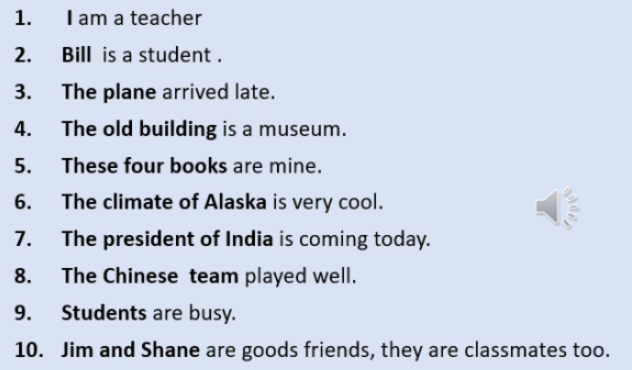
Getting an idea of the subject is very essential in making sentences in English. The Term subject has different meanings in different contexts, in this lesson, the term subject is a person place, or anything (anything: physical or virtual). A subject may be a single letter word for example: ‘I’ or a group of words ‘The President of India‘. Usually in an English sentence, the subject comes at the beginning of a sentence for example:
Stars are far away.
She is a singer.
In some sentences, the subject is left out, for example:
sit quietly. (= you sit quietly)
Don’t move from here, till I say. (= you don’t move from here till I say)
Subject may come in the middle or at the end of a sentence too for example:
May God bless you. (A bessing sentence)
May you live longer? (A blessing sentence)
Topic 2B – Subject can be a letter e.g. ‘I’ or , word or group of words. In the image below the bold letters indicate the subject of the sentence
Topic 2C – Why do we need to convert Subject to it’s pronoun form?
In a sentence every subject is followed by a verb (A verb is an important word in a sentence) wrong choice of a verb would make the sentence awful.
I am a teacher (I= subject, am = verb) – The subject ‘I‘ agrees with the verb ‘am’ (I >am)
They are my friends (They = subject, are = verb) The subject ‘they’ agrees with the verb ‘are’ (They > are)
Mary works for a Bank (Mary = subject, works = verb). The subject ‘Mary’ agrees with the verb ‘works’
(Mary > works)
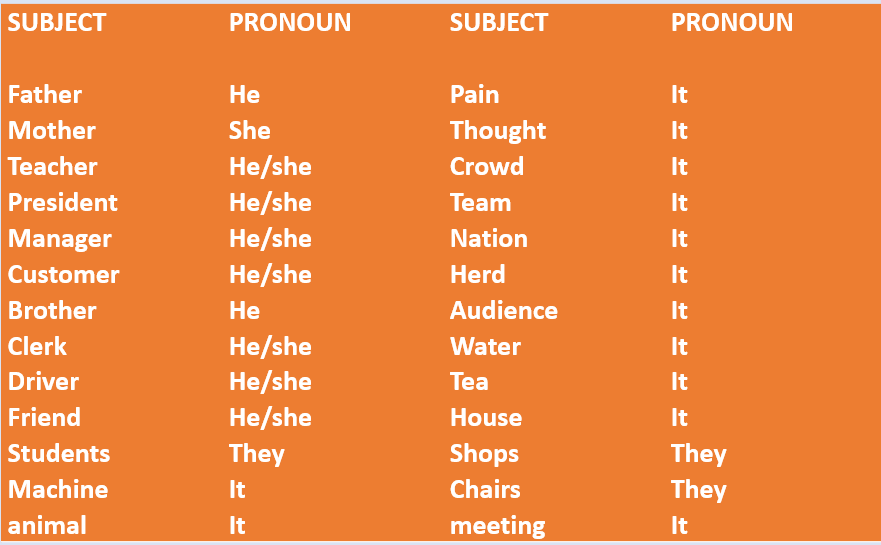
We talk about hundreds of subjects in our day-to-day conversations, for example, we talk about weather, education, government, friends, price-rise, travel, etc., now a question arises how to find suitable verbs for each subject? To solve this problem it’s a good idea to convert the subject into its pronoun form mentally before speaking or writing and reconvert them into their original form during the speech or writing. This conversion would help us to choose a suitable verb for any subject under the sun.
For example, when you speak about a bank mentally think of its pronoun form (it)
e.g. 1. A bank is a place to keep our cash safely (A bank = it is a place to keep our cash safely)
2. Mother Teresa was an Indian (Mother Teresa = she was an Indian)
Topic 2D – Conversion of a subject to its pronoun form
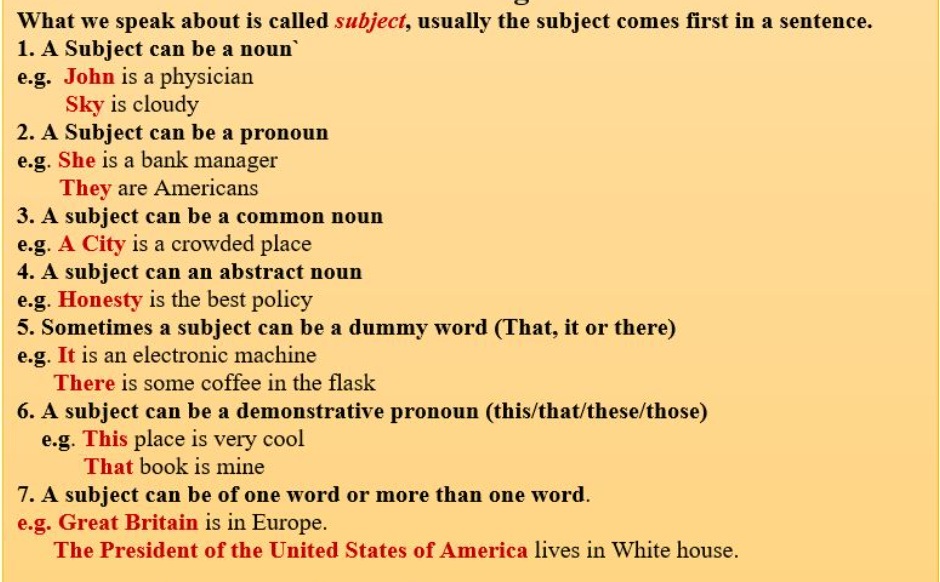
Topic 2E – A subject may take several noun forms, look at the following examples:
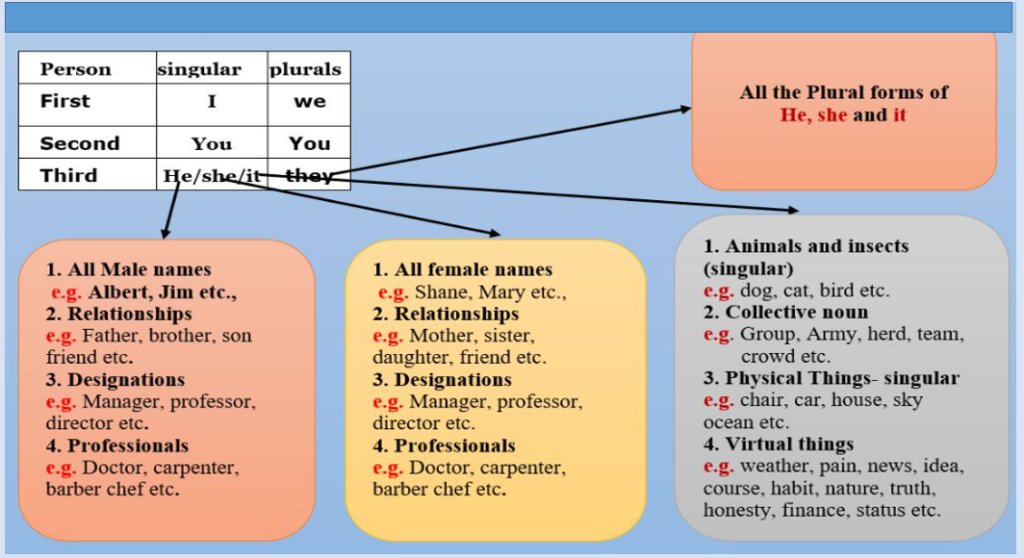
Topic 2F – Extended forms of the subjects ‘he, she, it and they’
Back to headline
Topic 2G – Introduction to Verbs in English
A verb is a word used to describe an action, occurrence, or state of being. Verbs are essential components of sentences because they express what the subject does, experiences, or is. Another simple definition of the verb is ‘ It’s the most important word in a sentence’)
Types of Verbs (Note only essential verbs: Action verbs, Modal verbs and Helping verbs)
1. Action Verbs
- Definition: Express actions that a subject performs.
- Examples: run, write, jump, think, eat
- Types of Action Verbs:
- Transitive Verbs: Require an object to complete their meaning.
- Example: She reads a book. (reads acts on the object book.)
- Intransitive Verbs: Do not require an object.
- Example: He runs every morning. (runs does not act on an object.)
- Transitive Verbs: Require an object to complete their meaning.
NOTE: Action verbs are categorized into regular and Irregular Verbs
- Regular Verbs: Form their past tense and past participle by adding “-ed” or “-d.”
- Example: talk → talked
- Irregular Verbs: Form their past tense and past participle in unpredictable ways.
- Example: go → went → gone
You can get a printout of irregular verbs from any web resources, regular verbs printout is not necessary as they are easy to make.
2. Linking Verbs
- Definition: Connect the subject to more information about the subject (a subject complement). These verbs do not show action.
- Examples: be, seem, become, appear, feel
- Example in a sentence: She is a doctor. (is links the subject she to the complement doctor.)
3. Helping (Auxiliary) Verbs
Look at this sentence: She is a teacher:
She is a teacher (‘is’ the only verb in the sentence so it’s the main verb)
He reads newspaper daily (‘reads’ is the only verb in the sentence so it’s the main verb)
She is teaching English. (Therre are two verbs in this sentence: is and teaching) the verb is helps the main verb teach so that it can behave like a continuous action verb. Is plays a role of helping, so it’s called helping or auxiliary verb.
NOTE: A verb like ‘do’ can acat as a main verb as well as helping verb in a same sentence, for example
What do-1 you do-2 for a lving? (The first do is a helping verb as it helps the senences to bcome a question and the second do act a main verb)
In short helping verbs help the main verbs to behave like a question sentencce, a negative sentencce
- Definition: Help the main verb to form tense, mood, or voice.
- Examples: is, are, was, were, have, has, do, will, shall
- Example in a sentence: They are running late. (are helps the main verb running to show present continuous tense.)
4. Modal Verbs – (A unique thing about these verbs is that they need not agree with the subject of a sentence so it’s easier to make sentences with Modal verbs for the begnners, a separate topic will be introduced soon)
- Definition: A type of auxiliary verb that expresses necessity, possibility, permission, or ability.
- Examples: can, could, may, might, must, shall, should, will, would
- Example in a sentence: You must study for the exam.
5. Stative Verbs
- Definition: Describe a state or condition rather than an action.
- Examples: know, believe, like, own, belong
- Example in a sentence: She knows the answer.
6. Dynamic Verbs
- Definition: Express physical or mental actions.
- Examples: run, think, eat, sing
- Example in a sentence: He sings beautifully.
7. Phrasal Verbs
- Definition: Verbs combined with prepositions or adverbs, often changing the verb’s meaning.
- Examples: look after, give up, break down
- Example in a sentence: She gave up smoking.
Understanding these types of verbs helps in constructing meaningful and grammatically correct sentences.
End of the topic 2
Topic 1 – Essential Grammar Ideas (will be updated soon)
Personal Pronouns, Possessive Pronouns & Reflexive (Emphatic) Pronouns
| S.No | Subject Pronoun | Object Pronoun | Possessive-1 (Adjective) | Possessive-2 (Pronoun) | Emphatic / Reflexive Pronoun | Tamil Meaning |
|---|---|---|---|---|---|---|
| 1 | I | me | my | mine | myself | நான், என்னை, என், என்னுடையது, நானே |
| 2 | we | us | our | ours | ourselves | நாம்/நாங்கள், எங்களை, எங்கள், எங்களுடையது, நாங்களே |
| 3 | you | you | your | yours | yourself | நீ, உன்னை, உன், உன்னுடையது, நீயே |
| 4 | you | you | your | yours | yourselves | நீங்கள், உங்களை, உங்கள், உங்களுடையது, நீங்களே |
| 5 | he | him | his | his | himself | அவன், அவனை, அவன், அவனுடையது, அவனே |
| 6 | she | her | her | hers | herself | அவள், அவளை, அவள், அவளுடையது, அவளே |
| 7 | it | it | its | its | itself | அது, அதை, அதன், அதனுடையது, அதுவே |
| 8 | they | them | their | theirs | themselves | அவர்கள், அவர்களை, அவர்களின், அவர்களுடையது, அவர்களே |
| 9 | who | whom | whose | — | — | யார், யாரை, யாருடைய |
Lesson: Using Subject, Object, Possessive and Reflexive Pronouns
1 I saw him in the market.
நான் அவனை சந்தையில் பார்த்தேன்.
2 He helped me with my project.
அவன் என் திட்டத்திற்கு எனக்கு உதவினான்.
3 This book is mine.
இந்த புத்தகம் என்னுடையது.
4 I completed the work myself.
நானே அந்த வேலையை முடித்தேன்.
5 We invited them to our house.
நாங்கள் அவர்களை எங்கள் வீட்டிற்கு அழைத்தோம்.
6 The victory is ours.
இந்த வெற்றி எங்களுடையது.
7 We prepared the report ourselves.
நாங்களே அறிக்கையைத் தயாரித்தோம்.
8 You gave me your pen.
நீ உன் பேனாவை எனக்கு கொடுத்தாய்.
9The decision is yours.
முடிவு உன்னுடையது.
10 You should trust yourself.
நீ உன்னையே நம்ப வேண்டும்.
11 She called him and gave her opinion.
அவள் அவனை அழைத்து தனது கருத்தை கூறினாள்.
12 That handbag is hers.
அந்த கைப்பை அவளுடையது.
13 The solved the problem herself.
அவளே அந்த பிரச்சினையைத் தீர்த்தாள்.
14 He repaired his bicycle himself.
அவனே தனது மிதிவண்டியை பழுது பார்த்தான்.
15 This is his laptop, and that one is hers.
இது அவனுடைய மடிக்கணினி; அது அவளுடையது.
16 The cat cleaned itself.
பூனை தன்னைத்தானே சுத்தம் செய்தது.
17 Its tail is very long.
அதன் வால் மிகவும் நீளமாக உள்ளது.
18 They invited us to their office.
அவர்கள் எங்களை அவர்களின் அலுவலகத்திற்கு அழைத்தார்கள்.
19 The success is theirs.
இந்த வெற்றி அவர்களுடையது.
20 They completed the task themselves.
அவர்களே அந்த பணியை முடித்தார்கள்.
Quick Review Exercise
Fill in the blanks with the correct pronoun.
- This car belongs to me. It is ________.
- Ravi repaired the machine ________.
- We completed the project by ________.
- That house is ________ (belonging to them).
- She gave ________ (I/me) her notebook.
Answers
- mine
- himself
- ourselves
- theirs
- me
Pronoun Formula
Subject + Verb + Object
➡ I saw him.
➡ நான் அவனை பார்த்தேன்.
Subject + Possessive-1 + Noun
➡ My book is new.
➡ என் புத்தகம் புதியது.
Subject + Verb + Possessive-2
➡ The book is mine.
➡ புத்தகம் என்னுடையது.
Subject + Verb + Emphatic Pronoun
➡ She did it herself.
➡ அவளே அதைச் செய்தாள்.
This lesson helps learners understand how English pronouns correspond to Tamil forms and how they are used naturally in sentences.
Possessive-1 vs Possessive-2
(Same Context – Two Different Sentence Patterns)
| Possessive-1 (with a noun) | Possessive-2 (without repeating the noun) | Tamil Translation |
|---|---|---|
| 1. This is my book. | This book is mine. | இது என் புத்தகம். / இந்த புத்தகம் என்னுடையது. |
| 2. That is her car. | That car is hers. | அது அவளுடைய கார். / அந்த கார் அவளுடையது. |
| 3. These are our bags. | These bags are ours. | இவை எங்கள் பைகள். / இந்த பைகள் எங்களுடையவை. |
| 4. Is this your pen? | Is this pen yours? | இது உன் பேனாவா? / இந்த பேனா உன்னுடையதா? |
| 5. Their house is large. | That house is theirs. | அவர்களின் வீடு பெரியது. / அந்த வீடு அவர்களுடையது. |
Rule to Remember
Possessive-1 + Noun
- my book
- your pen
- her car
- our bags
- their house
Pattern:
Possessive-1 + Noun
Example:
My book is new.
என் புத்தகம் புதியது.
Possessive-2 (No Noun After It)
- mine
- yours
- hers
- ours
- theirs
Pattern:
Noun + is/are + Possessive-2
Example:
This book is mine.
இந்த புத்தகம் என்னுடையது.
Quick Formula
| Possessive-1 | Possessive-2 |
|---|---|
| my book | the book is mine |
| your pen | the pen is yours |
| her car | the car is hers |
| our bags | the bags are ours |
| their house | the house is theirs |
Easy Memory Trick:
Possessive-1 needs a noun after it.
Possessive-2 stands alone.